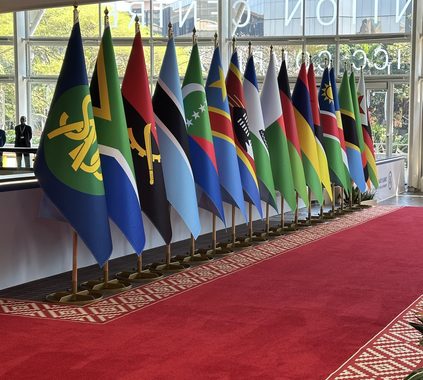
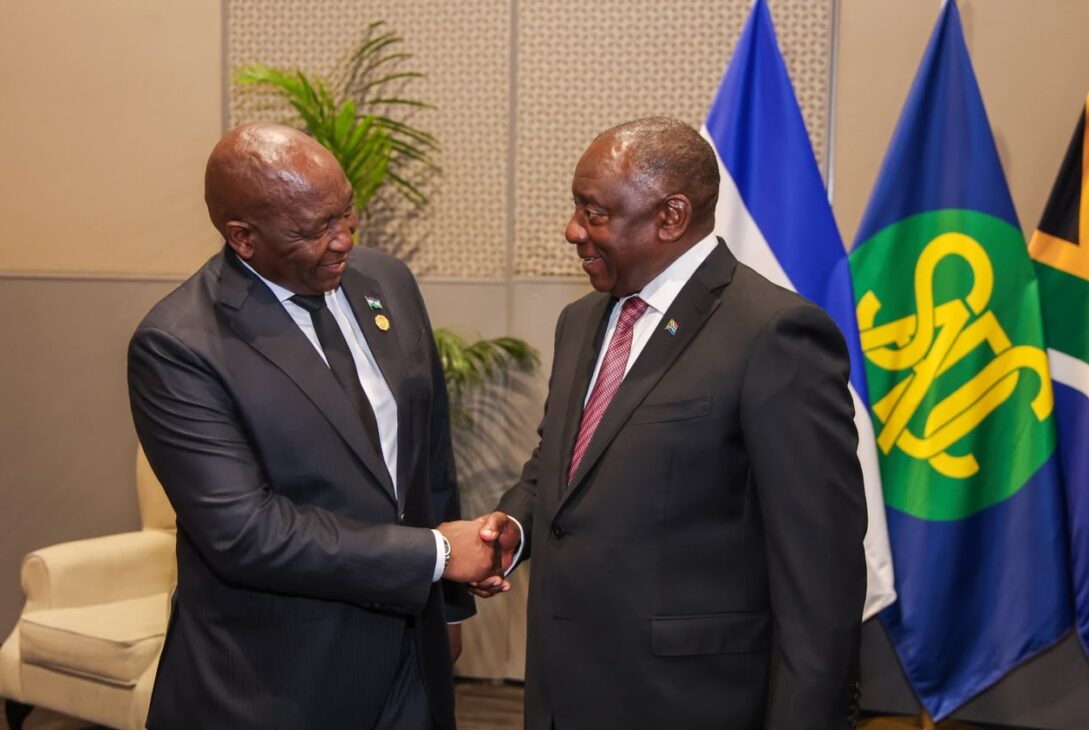
President Cyril Ramaphosa and the Prime Minister of the Kingdom of Lesotho, the Right Honourable Samuel Ntsokoane Matekane, are meeting in Durban as regional leaders gather for the 46th Ordinary Summit of Heads of State and Government of the Southern African Development Community (SADC).
The bilateral engagement comes at a significant moment for Southern Africa with South Africa preparing to assume the chairship of SADC and placing renewed emphasis on regional integration, infrastructure development, water security, economic cooperation and the movement of people across borders.
South Africa and Lesotho share a relationship shaped by geography, history and culture. Their bilateral partnership is supported by the Bi-National Commission, which provides a framework for addressing issues of mutual interest and strengthening cooperation between the two governments.
The meeting between President Ramaphosa and Prime Minister Matekane provides an opportunity to take stock of this relationship while advancing areas of cooperation that have direct consequences for millions of people in both countries.
One of the most important issues on the bilateral agenda is the Lesotho Highlands Water Project, a long-standing partnership that has become central to South Africa’s water security while also contributing significantly to Lesotho’s economic development.
The project transfers water from the highlands of Lesotho into South Africa’s Vaal River system, while generating economic benefits and supporting hydropower development in Lesotho. Its second phase, which includes the construction of the Polihali Dam and associated infrastructure represents one of the largest infrastructure partnerships between the two countries.
Phase II is expected to increase water transfers to South Africa by more than 400 million cubic metres annually once fully operational. The project is therefore strategically important at a time when South Africa faces growing pressure on its water resources as a result of population growth, urbanisation, industrial demand and climate related pressures.
For Lesotho, the project provides employment, infrastructure and financial benefits, including substantial royalty revenues from water supplied to South Africa. The partnership consequently represents a relationship of mutual dependence with Lesotho’s water resources contributing to South Africa’s economic and social stability, while South African investment supports infrastructure and development in Lesotho.
Recent progress on the project has further demonstrated the practical nature of the relationship. In April 2026, President Ramaphosa joined Prime Minister Matekane and King Letsie III for the co-launch of the Senqu Bridge in Lesotho. The bridge forms part of Phase II of the Lesotho Highlands Water Project and is designed to replace infrastructure that will eventually be affected by the impoundment of the Polihali Dam.
Beyond water and infrastructure, migration is expected to remain an important component of discussions between the two governments. The movement of people between South Africa and Lesotho is deeply rooted in the history of the two countries. Families, workers, businesses and communities have maintained cross-border connections for generations. At the same time, both governments face the challenge of managing irregular migration, border pressures, human trafficking, smuggling and other forms of cross border crime.
The development of a sustainable and mutually beneficial migration management framework could therefore become an important area of future cooperation. Such an approach would need to balance effective border management and national security with the realities of legitimate travel, employment, trade, family relationships and economic activity between the two countries.
The issue also has a wider regional dimension. SADC’s broader integration agenda seeks to improve the movement of people, goods and services across Southern Africa while strengthening economic cooperation and regional value chains. The discussions between Ramaphosa and Matekane are therefore taking place against a much larger regional backdrop.
The 46th SADC Summit is expected to focus on the region’s economic and development priorities, including infrastructure, agricultural transformation, industrialisation and the sustainable development of critical minerals. These priorities are increasingly being viewed as essential to building resilient economies capable of creating employment and reducing the region’s dependence on the export of unprocessed commodities.
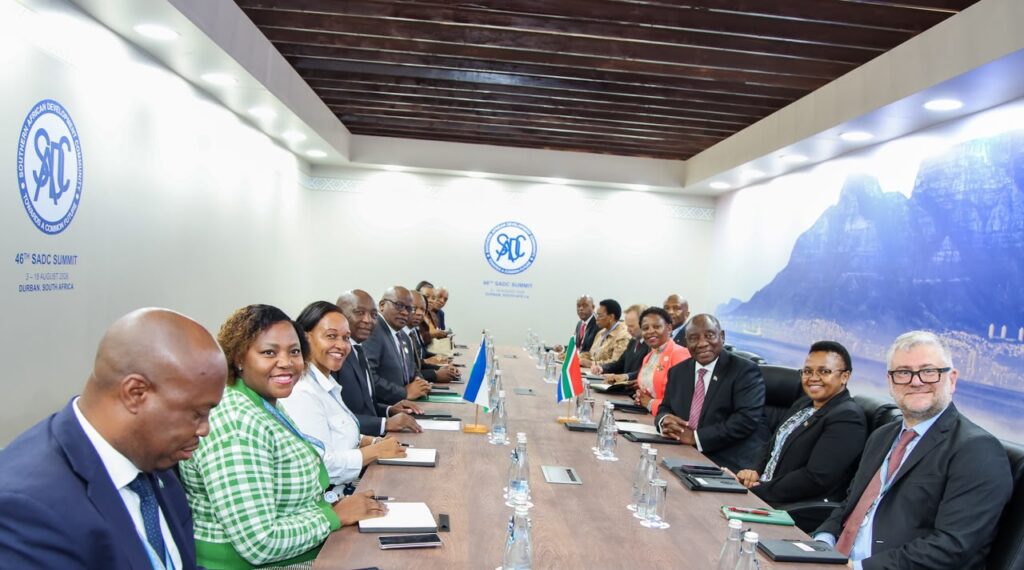
South Africa’s upcoming role as SADC Chair will place additional responsibility on Pretoria to help drive these priorities forward. The country will need to work with neighbouring states to strengthen regional infrastructure, improve trade and investment, address energy and water challenges and support peace and stability across the region.
For Lesotho, maintaining a strong relationship with South Africa remains particularly important because of the two countries’ close economic and geographical links. South Africa is Lesotho’s dominant economic partner while Lesotho’s natural resources and strategic position make cooperation important to South Africa’s own long term interests.
The relationship, however, also requires careful management. Major infrastructure projects must continue to deliver benefits to communities while addressing environmental and social concerns. Migration policies must protect national interests without undermining legitimate movement between communities. Economic cooperation must create opportunities that are meaningful for ordinary citizens rather than remaining confined to government and business institutions.
The Ramaphosa-Matekane engagement in Durban is consequently more than a routine diplomatic meeting. It is an opportunity for the two leaders to reinforce a partnership that has become increasingly important to water security, infrastructure development, economic cooperation and regional integration in Southern Africa. It also comes as SADC considers how to transform regional commitments into practical outcomes for its citizens.
For communities on both sides of the South Africa and Lesotho border, issues such as water, roads, employment, migration, trade and access to economic opportunities are not simply matters of diplomacy. They are part of everyday life. The success of the bilateral partnership will ultimately be measured by its ability to translate political cooperation into tangible improvements for people.
As Durban becomes the centre of Southern African diplomacy, the engagement between President Cyril Ramaphosa and Prime Minister Samuel Matekane provides an important opportunity to reaffirm the depth of South Africa and Lesotho’s relationship and to build on their shared interests.
The message from the meeting is likely to extend beyond the borders of the two countries: that Southern Africa’s future will depend on stronger partnerships, shared infrastructure, responsible management of natural resources and regional cooperation that delivers practical benefits to its people.