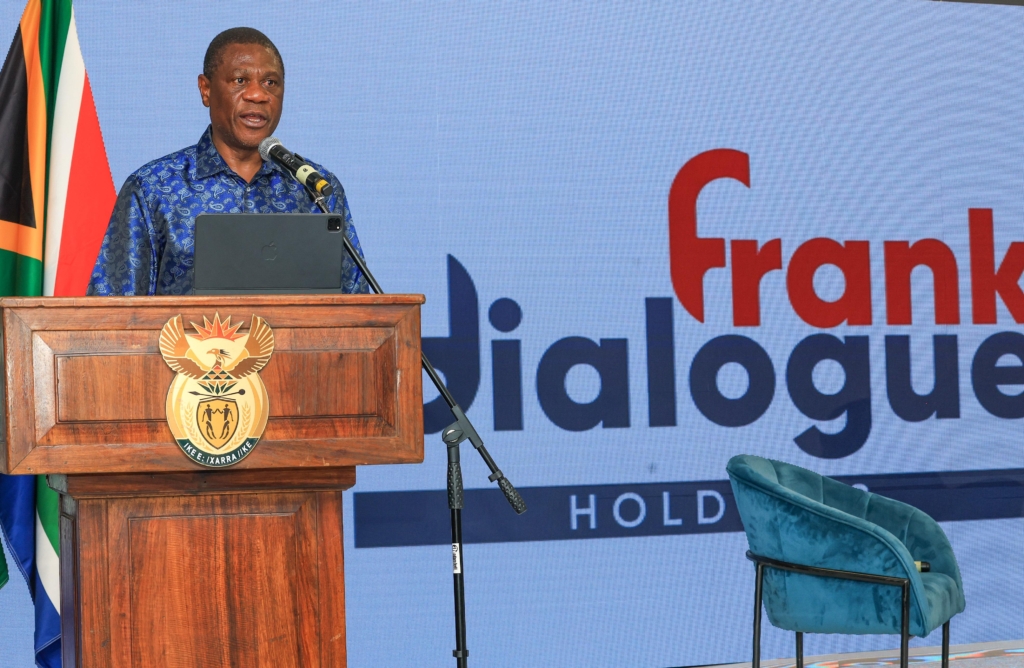
Deputy President Paul Mashatile arrived at the Coastlands uMhlanga Hotel and Convention Centre in Durban, KwaZulu-Natal, to participate in the Frank Dialogue on the Future of Broad-Based Black Economic Empowerment (B-BBEE) in South Africa.
The full-day dialogue brought together leaders from business, government, civil society and the ocean economy sector to discuss current developments shaping the empowerment landscape. Participants also tabled practical recommendations aimed at strengthening South Africa’s economic transformation agenda.
Upon arrival, the Deputy President was received by the Minister of Trade, Industry and Competition, Mr Parks Tau; KwaZulu-Natal MEC for Transport and Human Settlements, Mr Siboniso Duma; Frank Dialogue Convener, Prof JJ Tabane and Dr Nthabiseng Moleko, Chairperson of the National Economic Fund B-BBEE Advisory Council.
B-BBEE is a South African government policy and legislative framework established under Act 53 of 2003. It is designed to advance economic transformation and increase the meaningful participation of black people in the economy. The policy seeks to address historical economic inequalities and promote inclusive economic growth and unity.
During the dialogue, Deputy President Mashatile led robust discussions on the future of B-BBEE. He echoed President Cyril Ramaphosa’s position that B-BBEE should not be viewed as a cost to business but rather as an investment in sustainable and inclusive economic growth.
The Deputy President called for a decisive shift from compliance to measurable outcomes from rhetoric to implementation and from exclusion to productive inclusion. He stressed that there must be no retreat from transformation.
He further emphasized that policy legitimacy must be grounded in tangible results. Paper-based compliance, fronting and exclusion he noted, undermine trust in the system.
The Deputy President also highlighted the need to dismantle structural barriers such as market concentration, procurement biases and persistent skills deficits which continue to marginalise black-owned enterprises particularly in sectors such as agriculture and the ocean economy.
In closing, he identified five priority areas to track progress in transformation: procurement, access to finance, supplier development and graduation, management control and strengthened enforcement.