
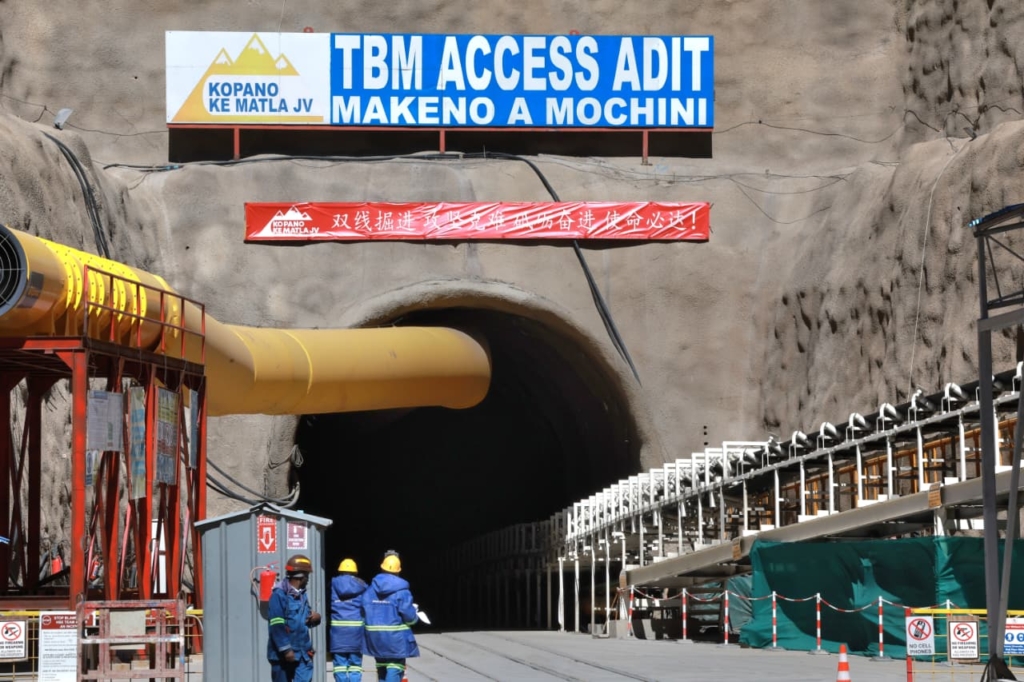
A bold new chapter in Southern Africa’s infrastructure story is unfolding, one that runs deep beneath the earth rather than across it. At the centre of this moment is the launch of a massive Tunnel Boring Machine (TBM), marking a critical milestone in Phase II of the Lesotho Highlands Water Project.
At its core, the initiative reflects a long-standing collaboration between South Africa and Lesotho to address water security while advancing economic development. Phase II deepens this vision by linking the Polihali and Katse dams through a 38.5-kilometre transfer tunnel, a gravity-driven system that will move water efficiently without the need for pumping. It is a design that blends technical sophistication with environmental and operational efficiency.
The TBM itself stands as an extraordinary feat of engineering. Measuring 423 metres in length and equipped with a 5.38-metre cutterhead, it operates as a fully integrated underground factory, advancing through rock formations under immense pressure. In some sections, it tunnels beneath more than 1,000 metres of overburden, cutting with precision through one of the region’s most challenging geological environments. Yet beyond its technical capabilities, the machine carries symbolic weight. As described during the launch, it represents an “umbilical cord” linking two neighbouring nations quietly but powerfully binding their futures together.
Its progress brings South Africa closer to a more secure water future, particularly for Gauteng, the country’s economic hub and most densely populated province. As demand continues to rise, the project will increase water transfer capacity significantly from 780 million to 1,270 million cubic metres per annum. At the same time, it will boost energy generation at the Muela Hydropower Station by approximately 30 percent, reinforcing the project’s dual contribution to water and energy security.
What makes this milestone especially significant is that it marks a transition from preparation to execution. Years of groundwork have culminated in this moment: access tunnels at both Polihali and Katse have been completed, assembly chambers constructed, and the first TBM successfully launched from the Katse side in January 2025. Since then, measurable progress has been made with over 600 metres excavated from Katse and more than 380 metres from Polihali. With both TBMs now operational, excavation proceeds simultaneously from both ends of the alignment, accelerating delivery and demonstrating tangible momentum.
Beyond its engineering scale, the project is deeply rooted in social and economic impact. It has already created employment for approximately 2,400 Basotho, the majority drawn from local communities. Skills development initiatives have trained over 1,100 individuals with more than 700 receiving formal certification. Local economic participation has exceeded M600 million with procurement processes supporting businesses across the region, including black-owned enterprises. In this way, the project extends its benefits beyond infrastructure, contributing directly to livelihoods and inclusive growth.
The scale of investment estimated at R9.2 billion places a clear responsibility on all stakeholders. The emphasis on accountability, transparency and integrity reflects an understanding that infrastructure of this magnitude must deliver measurable value.
Looking ahead, some of the most technically demanding work still lies ahead. The tunnel will ultimately connect into the Katse reservoir through a highly controlled underwater breakthrough known as the “lake tap,” a process requiring exceptional precision in both alignment and pressure control. It is at this critical juncture that the success of the entire undertaking will be tested.
The project’s delivery is the result of coordinated effort among multiple partners, including the Lesotho Highlands Water Commission and the Lesotho Highlands Development Authority, alongside engineers, contractors and thousands of workers whose daily efforts are turning vision into reality.
Ultimately, the launch of the TBM represents more than the start of excavation. It signals a broader trajectory one defined by stronger partnerships, smarter infrastructure and a shared commitment to long-term sustainability. Beneath the mountains of Lesotho, a tunnel is taking shape but above ground, something equally significant is being built: a model of regional cooperation and African capability.